
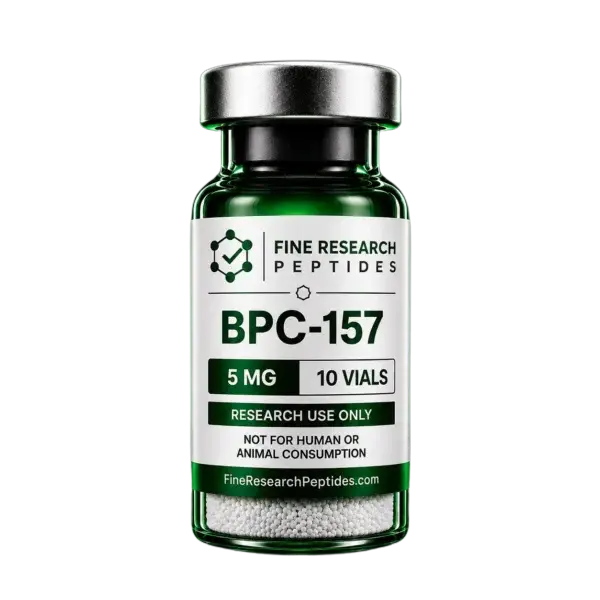
High-purity BPC-157 (Body Protection Compound 157) research peptide. Synthetic 15-amino acid pentadecapeptide. 99%+ HPLC verified by independent third-party laboratory. COA available before you order. USA domestic shipping with tracking. PCAC recommended Category 1 status July 2026. For laboratory research use only.
10mg per vial
2–3 Business Days from Texas
200-500mcg / 2-4 weeks
Note: BAC Water is required for reconstitution with all research peptides
Across the United States
Lab Verified
GMP Certified
Searching for a high-purity BPC-157 peptide for your research? Fine Research Peptides supplies BPC-157 as a research use only compound for USA laboratory researchers, with every batch independently verified for identity and purity by HPLC and mass spectrometry analysis before dispatch. Whether you need a single vial for pilot work or are stocking an extended multi-stage protocol, you can buy BPC-157 online in the USA with documented, independently verified quality behind every order.
This product is supplied strictly for laboratory research use only. It is not for human or animal consumption.
BPC-157, short for Body Protection Compound 157, is a synthetic pentadecapeptide consisting of exactly fifteen amino acids. Its sequence, Gly-Glu-Pro-Pro-Pro-Gly-Lys-Pro-Ala-Asp-Asp-Ala-Gly-Leu-Val, is derived from a partial sequence of a cytoprotective protein naturally present in human gastric juice. The molecular formula of BPC-157 is C62H98N16O22 with a molecular weight of approximately 1,419.5 g/mol. Its CAS number is 137525-51-0.
A particularly notable physical property of BPC-157 is its gastric stability. Unlike most peptides that degrade rapidly in acidic conditions, BPC-157 remains stable in human gastric juice for more than 24 hours, as confirmed in a 2026 peer-reviewed biopharmaceutical review published in Pharmaceutics [1]. This stability profile, combined with demonstrated biological activity across oral, parenteral, and topical administration routes in preclinical models, makes BPC-157 a practical and durable research tool across a range of experimental designs.
As of 2025, PubMed indexes over 190 publications containing the term BPC-157, covering research across gastrointestinal, musculoskeletal, vascular, neurological, and inflammatory biology [2]. This makes it the most extensively published non-approved synthetic research peptide currently available through compliant RUO channels in the USA.
A note on regulatory status: BPC-157 is not approved by the FDA for any indication. Fine Research Peptides supplies it strictly as a reference compound for laboratory research and never for diagnostic, therapeutic, or human use. For the complete regulatory framework, see our are peptides illegal guide and RUO peptides guide.
BPC-157 does not operate through a single receptor or signaling target. Preclinical research has characterised its activity across several overlapping biological pathways, which accounts for the breadth of its research applications across multiple organ systems.
One of the most studied BPC-157 mechanisms is its interaction with the nitric oxide signaling system. An independent research group from Taiwan demonstrated that BPC-157 disrupts the Caveolin-1 and eNOS inhibitory complex in isolated aortic tissue, directly promoting nitric oxide production in a dose-dependent manner [3]. Nitric oxide plays a central role in vascular regulation, wound healing signaling, and gastrointestinal mucosal cytoprotection. The NO system mechanism is considered one of the primary pathways connecting BPC-157’s preclinical findings across cardiovascular, gastrointestinal, and tissue repair research models.
Multiple preclinical studies have reported that BPC-157 activates VEGF receptor pathways and promotes new blood vessel formation at wound sites and in ischemic tissue models [4]. This pro-angiogenic activity is particularly relevant to musculoskeletal tissue repair research, where vascularization of avascular tissue compartments such as tendon and cartilage is a critical bottleneck in healing biology. The VEGF mechanism connects directly to the tendon and ligament repair findings that represent the largest body of BPC-157 musculoskeletal research.
BPC-157 research has identified FAK (focal adhesion kinase) and paxillin signaling as a third mechanistic pathway. FAK is a key mediator of cell migration in fibroblasts and endothelial cells. BPC-157 has been reported to activate the FAK-paxillin pathway in cell models, promoting directed cell migration toward wound sites and contributing to the tissue repair response studied in preclinical wound healing paradigms [4].
In musculoskeletal tissue models specifically, Egr-1 driven fibroblast activation and TGF-beta-mediated collagen type I synthesis have been identified as contributing mechanisms in connective tissue repair research [1]. Egr-1 is a transcription factor involved in the early wound healing response and its activation by BPC-157 in fibroblast models provides a mechanistic link between receptor-level activity and the collagen deposition outcomes observed in tendon and ligament repair studies.
For a comprehensive overview of all four BPC-157 mechanisms and the published research findings across organ systems, see our dedicated BPC-157 research guide.
The BPC-157 research findings span more than three decades of preclinical investigation and cover several major biology categories.
BPC-157 tissue repair research in musculoskeletal models represents the largest single body of preclinical evidence. A 2025 systematic review published in the HSS Journal by researchers at Case Western Reserve University School of Medicine identified 36 relevant studies, of which 35 were preclinical and one was a small retrospective clinical analysis [2]. The review confirmed consistent preclinical efficacy across musculoskeletal endpoints in models of Achilles tendon transection, ligament injury, skeletal muscle laceration, and bone fracture, reporting accelerated structural repair, improved biomechanical parameters, and enhanced functional recovery in treated animals.
A separate 2025 systematic review in Current Reviews in Musculoskeletal Medicine by McGuire et al. at the University of Utah confirmed the same pattern: consistent preclinical efficacy with near-complete absence of controlled human data as the primary gap [5].
The gastrointestinal system was the original research focus for BPC-157, given its gastric protein origin. Preclinical research has examined BPC-157 in models of gastric ulcer healing, inflammatory bowel disease, intestinal anastomosis repair, esophageal injury, and colitis induction. Mucosal healing, reduced inflammatory marker expression, and improved intestinal integrity endpoints have been consistently reported across rodent gastrointestinal models.
A subset of BPC-157 research has examined neurological models including peripheral nerve crush injury, spinal cord injury, and traumatic brain injury paradigms in rodents. Vascular models examining endothelial cell behavior and blood pressure regulation through NO mechanisms have also been studied. These research areas connect directly to the NO system and VEGF mechanisms described above.
The 2026 regulatory developments around BPC-157 are the most significant in the compound’s research history and are directly relevant to any researcher evaluating the current legal status of BPC-157 for laboratory work.
Following HHS Secretary Robert F. Kennedy Jr.’s February 2026 announcement that 14 peptides previously on the FDA Category 2 restricted compounding list would be returned to Category 1 status, the FDA’s Pharmacy Compounding Advisory Committee (PCAC) formally reviewed BPC-157 at its July 23 to 24, 2026 meeting at the FDA White Oak Campus. The PCAC voted 8 to 6 on July 23, 2026 to recommend BPC-157 for the 503A Bulk Drug Substances List, overruling FDA staff scientists who had raised evidence concerns.
Researchers need to understand two critical points about this vote clearly.
First, the PCAC recommendation is non-binding. The FDA is not obligated to adopt the committee vote in its final rulemaking determination. If adopted, it would restore BPC-157’s eligibility for licensed 503A compounding pharmacy preparation under physician prescription. This is not FDA approval. It is compounding pharmacy access, which is a distinct regulatory category.
Second, this regulatory development does not affect the RUO research supply framework. BPC-157 is not a controlled substance under the Controlled Substances Act and has no scheduling restriction limiting its supply for laboratory research. Fine Research Peptides supplies BPC-157 as an RUO research compound under the existing framework regardless of how the compounding pharmacy classification question resolves.
For the complete regulatory context, see our are peptides illegal guide and our RUO peptides guide.
Fine Research Peptides stocks BPC-157 in two research quantities to suit different protocol scales.
BPC-157 5mg: Suited to smaller or preliminary research, pilot study designs, cell-based assay work, or researchers entering BPC-157 biology for the first time and establishing protocol parameters before scaling up.
BPC-157 10mg: The common quantity for extended in-vivo rodent studies, multi-replicate cell-based assay designs, or research programs requiring consistent batch material across multiple experimental sessions.
Every vial is supplied as a lyophilized powder held to the same 99%+ purity standard verified by independent third-party HPLC and mass spectrometry analysis before dispatch.
Quality across the open online BPC-157 market is inconsistent. This is not a generic disclaimer. FDA testing found that 40% of online research peptide products contained incorrect dosages and 25% contained compounds not listed on the label. For a compound used in biological research where experimental outcomes depend on what is actually in the vial, supplier selection is a quality decision.
Independent third-party testing, not self-certification Our BPC-157 is independently analyzed by a USA-based third-party laboratory using HPLC and mass spectrometry. COA documentation from the named external laboratory is available for review on our lab certifications page before you place your order.
USA domestic shipping with full tracking All orders ship domestically from within the USA with tracking on every order, eliminating the international temperature excursion risk and customs complications that affect compound integrity from overseas sources.
Consistent RUO compliance Every product page, article, and communication from Fine Research Peptides maintains correct Research Use Only framing. The vendor collapses of 2025 and 2026 specifically resulted from inconsistent RUO compliance. For quality verification guidance before purchasing from any supplier, see our how to verify research peptide quality guide.
For current BPC-157 pricing and a comparison across the full catalog, see our peptide pricing guide.
BPC-157 is supplied as a lyophilized powder requiring reconstitution with bacteriostatic water before laboratory use.
Common reconstitution reference volumes:
Use our free peptide calculator to calculate the exact solvent volume for your target concentration before reconstituting. Fine Research Peptides carries bacteriostatic water in sterile sealed 10ml vials for complete reconstitution setup.
For the full step-by-step laboratory reconstitution protocol covering aseptic technique, dissolution method, and storage, see our peptide reconstitution guide. For guidance on bacteriostatic water as the standard reconstitution solvent, see our BAC water guide.
Storage: Store lyophilized BPC-157 at -20°C before reconstitution and protect from light and moisture. After reconstitution, refrigerate at 2 to 8°C and use within 28 days. Do not freeze a reconstituted BPC-157 solution. Handled only in an appropriate laboratory setting by qualified personnel following institutional protocols.
Researchers designing comprehensive recovery or tissue repair study panels frequently include BPC-157 alongside related compounds for broader pathway coverage.
For combined tissue repair and cell migration research: TB-500 is a synthetic Thymosin Beta-4 analog studied in actin dynamics, G-actin sequestration, and connective tissue repair models. It covers complementary mechanisms to BPC-157’s VEGF and NO pathways. Researchers studying both can order the pre-formulated BPC-TB Blend for streamlined multi-compound protocol designs within the recovery research range.
For anti-inflammatory and mucosal research: KPV covers NF-kB inhibition and TNF-alpha reduction endpoints that complement BPC-157’s gastrointestinal mucosal research applications.
For skin biology and wound healing panels: GHK-Cu covers collagen synthesis and MMP modulation endpoints alongside BPC-157’s angiogenesis and tissue repair mechanisms in comprehensive wound healing study designs.
For longevity and cellular aging panels: Epithalon, MOTS-C, and NAD+ from our longevity range complement BPC-157 in multi-mechanism aging and regeneration study panels.
For a complete compound reference, see our list of research peptides and what they do and full research guide.
Select your vial size, 5mg or 10mg, on this page. Add to cart and proceed to checkout. You will receive an order confirmation by email once payment is processed. Tracking details are emailed when your order is dispatched from within the USA.
Before ordering, review COA documentation for the current batch on our lab certifications page. For any pre-order questions, visit our FAQs or reach us through our contact page. Learn more about Fine Research Peptides on our about page.
Browse our bestseller compounds, our full recovery research range, or our complete injectables catalog.
BPC-157 stands for Body Protection Compound 157. It is a synthetic pentadecapeptide of fifteen amino acids with a sequence derived from a cytoprotective protein found in human gastric juice. Its molecular weight is approximately 1,419.5 g/mol and it is notable for its unusual stability in gastric juice for over 24 hours. Over 190 PubMed-indexed publications cover BPC-157 research across gastrointestinal, musculoskeletal, vascular, and neurological contexts. Fine Research Peptides supplies it for laboratory research use only.
A 2025 systematic review in the HSS Journal confirmed consistent preclinical efficacy across 35 musculoskeletal preclinical studies covering tendon transection, ligament injury, muscle laceration, and bone fracture models. Primary mechanisms include VEGF-mediated angiogenesis, Egr-1 driven fibroblast activation, TGF-beta-mediated collagen type I synthesis, and FAK-paxillin cell migration promotion. The review highlighted the near-complete absence of controlled human data as the primary evidence gap.
BPC-157 is not FDA approved and is not a controlled substance. The PCAC voted 8 to 6 on July 23, 2026 to recommend BPC-157 for the 503A compounding bulks list, which would restore licensed pharmacy compounding access under physician prescription if the FDA adopts the recommendation. This is not FDA approval. The RUO research supply framework is unaffected by this regulatory development. Fine Research Peptides supplies BPC-157 for laboratory research under the existing RUO framework.
Yes. BPC-157 is legal to purchase for legitimate laboratory research from a compliant RUO supplier. It is not a controlled substance and has no scheduling restriction limiting research supply. For the full legal context, see our are peptides illegal guide.
Yes. Our BPC-157 is independently analyzed by a USA-based third-party laboratory using HPLC and mass spectrometry. A batch-specific COA is available for review on our lab certifications page before you place your order.
Fine Research Peptides stocks BPC-157 in 5mg and 10mg lyophilized vials, both at 99%+ purity verified by independent third-party analysis.
Add bacteriostatic water slowly along the inside wall of the lyophilized BPC-157 vial and gently swirl until fully dissolved. For a 5mg vial, adding 2ml produces a 2.5mg/ml solution. For a 10mg vial, adding 2ml produces a 5mg/ml solution. Use our peptide calculator to calculate the exact volume for your target concentration. Store at 2 to 8°C after reconstitution and use within 28 days.
You can buy BPC-157 research peptides online directly from Fine Research Peptides. We are a USA-based compliant RUO supplier with domestic shipping, tracking on every order, and independent COA documentation available before ordering. Visit our shop for current availability.
All products supplied by Fine Research Peptides are strictly for laboratory and research use only. BPC-157 is not approved by the FDA for any indication and is not intended for human or animal consumption. All published research findings referenced on this page are drawn from peer-reviewed literature and do not constitute therapeutic claims, health benefit statements, or medical guidance. Researchers are responsible for ensuring full compliance with all applicable local, state, and federal regulations governing the purchase, storage, and use of research compounds in their jurisdiction.
BPC-157 research has shown remarkable effects on:
Studies have demonstrated BPC-157’s potential in:
Laboratory research explores BPC-157’s role in:
200mcg to 500mcg daily for 2-4 weeks
Administered via subcutaneous or intramuscular injection near the affected area
Every lot of BPC-157 is tested by an independent U.S. laboratory. Match the lot number on your label to its report, any time.

Ordering, shipping and handling, in plain language. Still
unsure? Contact support.
All products are supplied strictly for laboratory research. Not for human or animal consumption.
Ordering is simple.
It is a straightforward way to buy peptides online with confidence, knowing everything is supplied strictly for laboratory research and independently verified.
Certain peptide-based medications have received FDA approval for specific clinical uses, but the research peptides sold by Fine Research Peptides are not FDA approved and are not intended for human or animal use.
Yes. All products are shipped in stable lyophilized (freeze-dried) form and packaged to shield them from direct sunlight and unnecessary exposure during transit, helping preserve integrity until they reach your lab.
Once reconstituted, peptides are typically kept refrigerated between 2-8°C for short-term laboratory use.
Research use only.